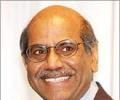
Speaking at an event in New Delhi, jointly held by National Thermal Power Corporation and the Confederation of Indian Industry, he added that developing countries should also not expect any financial or technical assistance from developed nations to help reduce their carbon footprint.

Pushing for a legally binding substantive outcome at the Copenhagen climate change meet, Prime Minister Manmohan Singh on Saturday said India is willing to sign on to an ambitious global target for emission reduction or limiting temperature increase, if it is accompanied by an equitable burden-sharing paradigm. He denounced attempts by some developed nations to junk the Kyoto Protocol on greenhouse gas emissions.

India has chosen to count itself in that centre, a choice that clearly unhinges it from the South. It is also a choice, the consequences of which will be difficult to undo, going forward.
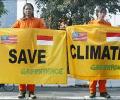
Negotiations to hammer out an 'equitable and fair' deal on climate change were deadlocked on Wednesday, even as hundreds of climate activists were tear-gassed, beaten up and detained for trying to break into the UN-sponsored Climate Summit in Copenhagen and establish a 'people's assembly', accusing the 193 participating countries of not trying to reach a new deal to combat the menace.

We dumped Kyoto because of the US - but even the diluted US-inspired Copenhagen accord is in peril.

If India wishes to lead the environmental battle for the developing world, it must come out in the open with a clear outline of goals.

It has been a prickly year for China-India ties with the Arunachal Pradesh boundary dispute poisoning bilateral rhetoric. In Copenhagen, Hindi-Chini Bhai Bhai is back in vogue with the two sides holding meetings up to six times a day, according to Environment Minister Jairam Ramesh.

At Copenhagen, attempts to arrive at a fair deal on climate change were deadlocked with countries refusing to budge from their positions on sticky issues like emission cuts. Environment Minister Jairam Ramesh, who is leading the Indian delegation, said the BASIC group -- comprising India, China, South Africa and Brazil -- "is united and we would like to reiterate that we want an equitable and fair agreement to emerge out of the summit".
Prime Minister Manmohan Singh will attend the Copenhagen Summit on climate change on December 18, reflecting the seriousness attached by India to the meet where it is expected to play a crucial role.
Even if the leaders can't negotiate a binding agreement, many countries hope to work out commitments to reduce their greenhouse-gas emissions and provide assistance to poorer countries likely to be hardest hit by the effects of global warming.

The international climate change talks, which started in Copenhagen today, will see a 35-member official delegation from India. The attempt will be to negotiate a new global climate treaty to replace or extend the 1997 Kyoto Protocol beyond 2012.
Prime Minister Manmohan Singh arrived at Copenhagen on Friday morning to participate in the concluding session of the Climate Summit amid a ray of hope for a political statement on combating climate change.

India and China seemed to be on the same side at the Copenhagen Climate Summit, while the United States had to gatecrash to join hands.

Eminent economist Jagdish Bhagwati said India had made a mistake in aligning with China at the recent climate conference in Copenhagen. Instead, the country should have taken a leadership role in climate talks by coming forth with fresh ideas.

China and India are on different sides of the climate debate and, after the United States, Beijing has to make the most cuts.

The Conference of Parties must come up with a successor to the Kyoto Protocol which expires in 2012.

The 54-page Paris agreement draft had been scaled down to 50.

Some 80 presidents and premiers are expected to attend the final days of the conference on December 17-18. Obama might use his December 9 drop-by at the Copenhagen conference on his way to receive the Nobel Peace Prize in Oslo, Norway to announce a US offer on financing.

With three days left to seal a deal at Copenhagen, climate change champion Al Gore has called on developed and developing countries to reach "compromises" on their key differences for the sake of future generations.

India has said that developed countries should "not expect miracles" at the key Copenhagen climate summit in December and the goals sought for emission controls should be more "realistic."

The climate innovation centres are aimed at identifying and developing local technology requirements and also for facilitating dissemination of current technologies.

A day into the Copenhagen climate change meetings, the Union ministry of new and renewable energy has indicated that it has no definite roadmap to implement its ambitious target of 20,000 MW of solar power by 2022.

Government on Friday said it will not compromise India's interest at the Copenhagen climate change summit, but a dissatisfied opposition walked out in the Rajya Sabha.

Confusion prevailed over some reports from Beijing which quoted environment and forests minister, Jairam Ramesh, saying India will voluntarily reduce its carbon intensity by 20-25 per cent.

The US President is scheduled to arrive in Copenhagen early Friday morning local time. Obama will attend the morning plenary session of the United Nations Climate Change Conference and is expected to deliver brief address on the issue.
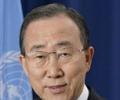
UN chief Ban Ki-moon on Tuesday said getting a binding agreement sealed on climate change was among his top priorities for the year after the Copenhagen conference that marked "an important step forward".

Pledging to reduce its emissions intensity by 20-25 per cent as done by China, India led by Prime Minister Manmohan Singh is ready to play a leadership role at the global climate summit at Copenhagen slated from Tuesday. Singh will join United States President Barack Obama and over 100 world leaders at the summit with the likelihood increasing of a consensus on a new global deal to replace the Kyoto Protocol which expires 2012.

There is no way the Copenhagen Accord can be billed as a climate change agreement. It is simply an agreement to legitimise the right to pollute.

Minister of State for Environment and Forests Jairam Ramesh said India will forward its domestic goals on climate change as its action plan under the Copenhagen Accord to the Conference of Parties (COP) of the UN Framework Convention on Climate Change (UNFCCC).

Several round of talks are expected to be held this year before the finale at Cancun in Mexico in December.

The Climate Change conference in Copenhagen last year yielded the contentious and non-binding Copenhagen Accord.
Seeking a constructive approach to move forward in the global efforts to combat climate change, Prime Minister Manmohan Singh said on Thursday that India is willing to do more provided there are 'credible' arrangements from rich nations on financial support and technology transfers.
Five top United Nations officials have urged world leaders to "seal the deal" at Copenhagen in December on an ambitious new climate change pact aimed at curbing greenhouse gas emissions.

Challenges posed by climate change hit centre stage in 2009 which saw the government doing a flip-flop ahead of the crucial Copenhagen summit even as the Opposition and experts alleged that India succumbed to pressure from rich nations on emission cuts.

Proposals are being worked upon at the Copenhagen summit to cut the greenhouse gas emissions in the atmosphere, prominent among which is the use of nuclear energy.
The divergent utterances by environment and forests minister Jairam Ramesh and prime minister's special envoy on climate change Shyam Saran have created a good deal of ambiguity within and outside the country over the government's strategy for these talks.

India decided to cut down its carbon emission intensity by 20-25 per cent by 2020 in the run up to the Copenhagen summit, shortly after a similar declaration by China.

British Prime Minister Gordon Brown said on Monday that UN climate summit in Copenhagen was 'held to ransom' by a small group of countries, as his climate secretary accused China of hijacking the talks to block a legally binding treaty.
The meeting between Dr Singh and Sarkozy on climate change assumes significance as it came just ten days before the Copenhagen Summit on the issue.

With less than two months to go for the climate-change summit in Copenhagen, India has resolved to re-brand itself as a deal-maker.
